SHANGHAI, China – As offshore energy projects push into deeper and more remote waters, the remotely operated vehicles (ROVs) that inspect pipelines, support subsea construction, and conduct scientific survey work are being asked to operate longer, dive deeper, and endure harsher conditions than ever before. Behind every one of those missions is a component that rarely makes headlines but increasingly determines whether an operation succeeds: the ROV cable.
Industry observers say the growth in offshore wind installation, deepwater oil and gas development, and subsea infrastructure inspection has placed new pressure on tether and umbilical cable manufacturers to solve engineering problems that were once considered acceptable trade-offs.
The Trade-Off That No Longer Works
For years, ROV operators have lived with a familiar compromise: cables built for maximum tensile strength tend to be heavy and difficult to maneuver, while lightweight, neutral-buoyancy cables trade away some of the load capacity needed for recovery operations and towed systems. As missions extend further from the surface support vessel and into stronger currents, that trade-off has become harder to accept.
“Operators used to choose one priority and design their mission plan around the limitation,” one subsea equipment engineer noted. “What’s changed is that deepwater and offshore wind projects increasingly need both — a cable that manages drag and entanglement risk in current, but still holds up under real recovery load. That’s not a small ask.”
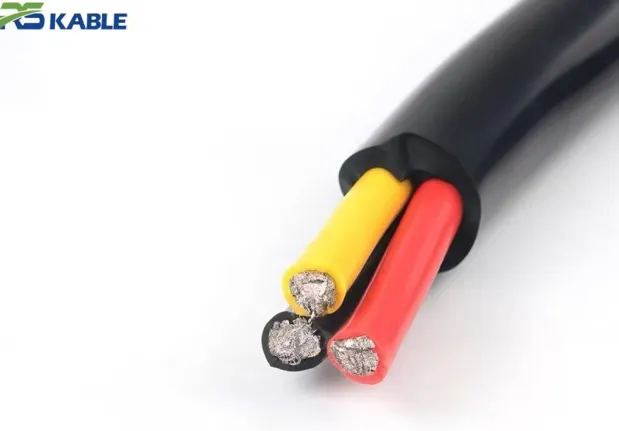
The response from manufacturers has centered on more deliberate construction choices rather than a single breakthrough material. Counter-helically wound armor layers, which cancel out rotational torque under tension, have become more common in cables built for heavy recovery duty. Neutral buoyancy formulations using foamed polymers and aramid fiber reinforcement continue to be refined to reduce drag without sacrificing the strength margins that survey and construction missions require.
Fatigue, Not Just Strength, Is the Real Design Problem
Engineers who work closely with tether cable specification say that mission life — not just peak tensile rating — has become the more decisive factor in cable selection. A cable that survives a single deep dive is a different engineering problem than one that must survive thousands of deployment and recovery cycles over a multi-year service contract.
That shift has pushed cable construction toward more rigorous attention to bend radius behavior, jacket abrasion resistance at winch and sheave contact points, and shielding integrity for the video and telemetry signals ROV pilots depend on. Video dropout and intermittent signal loss during active missions, once treated as a minor operational nuisance, are now more frequently traced back to cable fatigue at specific flex points rather than isolated component failure.
A Sector Under Growing Pressure to Perform
Offshore wind development in particular has introduced a new category of demand. Turbine foundation inspection, cable-laying support, and maintenance operations in coastal and shelf waters often involve stronger current conditions than traditional deepwater oil and gas work, placing additional strain on tether systems that were originally designed around calmer operating assumptions.
At the same time, extended-duration missions in oil and gas inspection and subsea construction have increased the total number of deployment cycles a single cable must survive before replacement — shifting the economics of cable selection away from upfront cost alone and toward total service life.
Manufacturers serving this market say the result has been a steady move toward more application-specific cable construction, rather than a one-size-fits-all approach to ROV tether design.
“The mission profile has to drive the cable spec now, not the other way around,” the engineer added. “A cable built for calm-water inspection work and one built for high-current recovery in an offshore wind field are genuinely different engineering problems, even if they look similar on paper.”
What Comes Next
As deepwater and offshore renewable projects continue to expand, industry participants expect cable manufacturers to face growing pressure to document real-world performance data — flex-cycle life, fatigue behavior under combined load and current, and long-term abrasion resistance — rather than relying on headline tensile and depth ratings alone.
For an industry where a single tether failure can end a mission hundreds or thousands of meters below the surface, that shift in expectations may prove to be the more significant development of 2026, even if it never makes a headline of its own.